Across Sierra Leone's Western Area Rural District, communities are confronting environmental pressures that increasingly affect their homes, livelihoods and futures. Deforestation, pollution, changing rainfall patterns, rising temperatures, coastal erosion, floods and landslides are no longer distant environmental concerns. They are everyday realities with consequences for livelihoods, food security and community well-being.
Yet communities facing these challenges do not always have access to the legal knowledge, practical tools and advocacy skills needed to protect their environment and demand accountability.
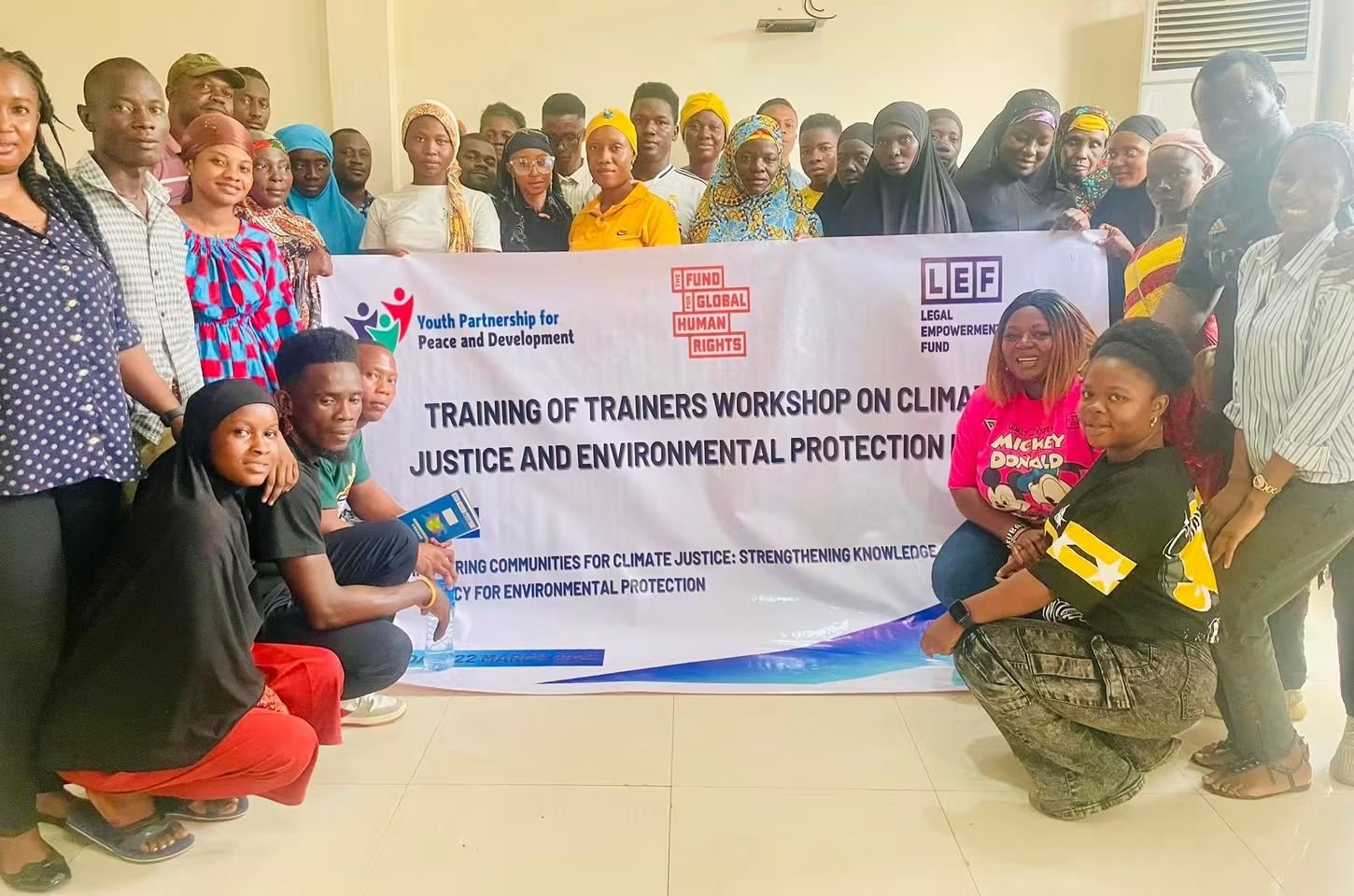
The Youth Partnership for Peace and Development (YPPD) is working to help close that gap. With funding from the Fund for Global Human Rights through the Legal Empowerment Fund, YPPD recently concluded a Training of Trainers (ToT) Workshop on Climate Justice and Environmental Protection Laws, bringing together 50 youth leaders, women representatives and community stakeholders from Koya, Fogbo, Macdonald, Bureh Town and Lakka.
The objective went beyond teaching participants about environmental laws. The training sought to develop a network of community educators and advocates capable of taking knowledge back to their communities and transforming it into grassroots action.
Understanding Climate Justice Through Community Realities
Facilitated by the Director of Policy, Research, and Monitoring & Evaluation at Sierra Leone's Ministry of Environment, the workshop combined technical knowledge with practical approaches to advocacy and community mobilization.
Participants explored the concept of climate justice and the unequal ways environmental and climate impacts affect communities. Discussions highlighted how vulnerable communities can bear significant consequences of climate change despite contributing comparatively little to its causes. For participants, the concept quickly connected with experiences in their own communities.
They discussed rising temperatures, unpredictable rainfall, coastal erosion and increasing incidents of flooding and landslides. These conversations reinforced an important message: environmental degradation is not simply about ecosystems.
It affects livelihoods, food security, safety and social well-being.
Understanding these connections enabled participants to see climate justice not merely as an international policy concept, but as an issue directly connected to the lives and rights of people within their communities.
Making Environmental Law Accessible to Communities
One of the workshop's major areas of focus was Sierra Leone's environmental legal framework. Many participants acknowledged having limited or no prior knowledge of some of the country's key environmental protection laws. Through interactive sessions, they were introduced to legislation including the Environmental Protection Agency Act (2022), the National Disaster Management Agency Act (2020) and other laws governing areas such as forestry, wildlife and mining.
This knowledge opened an important conversation about the relationship between laws on paper and environmental realities on the ground. Participants raised concerns about weak enforcement and insufficient community involvement. More importantly, they began exploring how communities could engage existing institutions and legal frameworks more effectively. Legal knowledge, in this context, became more than information. It became a pathway to participation and accountability.
Turning Rights Into Advocacy
Knowing that a law exists does not automatically enable communities to use it.
For this reason, the workshop placed considerable emphasis on rights-based advocacy.
Participants learned approaches for mobilizing communities, developing advocacy messages and engaging decision-makers. Storytelling, media engagement and collaboration with traditional leaders were explored as strategies for making community concerns visible and strengthening grassroots voices.
The training also introduced practical approaches to legal empowerment.
Participants explored options available to communities seeking accountability, including submitting complaints to regulatory institutions, accessing legal assistance and engaging with public-interest legal processes.
The aim was to change how participants understood the law—from something distant and technical into something communities can engage with to defend their rights and interests.
For some participants, that transition from knowledge to intended action was immediate.
In Macdonald, youth leaders expressed their intention to prepare formal complaints concerning mining companies they believe are not meeting their environmental responsibilities—an action directly inspired by knowledge gained during the workshop.
Five Communities, Locally Led Responses
A central strength of the Training of Trainers approach is that action does not end when the workshop closes. Participants returned to their communities with ideas for translating their learning into locally relevant initiatives.
In Koya, participants are planning town hall meetings and environmental clubs to increase awareness and community participation.
In Fogbo, youth groups are mobilizing around tree planting and land restoration.
Participants from Bureh Town are exploring sustainable farming and waste-management initiatives.
In Lakka, attention is turning toward early-warning systems and disaster preparedness.
Meanwhile, participants from Macdonald are considering how legal accountability mechanisms can be used to address environmental concerns associated with mining activities.
These commitments demonstrate why locally led climate action matters. Although communities may share environmental challenges, their priorities, vulnerabilities and solutions are not necessarily identical.
Equipping local actors enables communities to identify responses grounded in their own circumstances.
Training Trainers Creates a Multiplier Effect
By the conclusion of the workshop, the 50 participants were expected to be more than beneficiaries of a training programme.
They had been equipped as trainers and community advocates who could share knowledge, stimulate discussion and encourage action beyond the original group reached by the project.
This multiplier approach is particularly important for environmental justice. Communities need people who can explain environmental rights in accessible ways, connect local experiences with legal frameworks, organize collective action and help residents understand where and how they can seek accountability.
The workshop also strengthened connections among community groups, civil society and government institutions, creating opportunities for more coordinated environmental action.
What Communities Say Is Needed Next
Participants also recognized that a single training cannot address every barrier to environmental justice.
Their recommendations point toward several areas requiring continued investment and partnership.
Communities need simplified environmental legal information, including materials accessible in local languages, so that knowledge of environmental rights can extend beyond trained advocates.
Participants also highlighted the potential value of training community paralegals, who could help residents understand legal processes and navigate accountability mechanisms.
Stronger engagement with traditional leaders was identified as another priority because of their influence and role within communities.
And ultimately, legal empowerment must be accompanied by effective enforcement of environmental laws if communities are to see meaningful improvements.
These recommendations provide an important roadmap for YPPD and its partners as they consider how this initial investment can be deepened and expanded.

Building a Generation of Community Climate Justice Advocates
The Training of Trainers workshop represents an important step toward bridging the distance between communities and the laws and institutions intended to protect their environment.
Its underlying principle is straightforward: people are better positioned to defend their environment when they understand their rights, know the institutions responsible for protecting those rights and have the confidence and skills to take action.
For YPPD, climate justice is therefore also an issue of empowerment, participation and accountability.
By strengthening the knowledge and capacity of youth leaders, women and other community stakeholders, YPPD is helping communities move from being affected by environmental challenges to becoming better equipped to shape the responses to them.
The work is only beginning.
The commitments emerging from Koya, Fogbo, Macdonald, Bureh Town and Lakka demonstrate an appetite for community-led environmental action. Sustaining that momentum will require continued collaboration among communities, government institutions, traditional leaders, civil society, legal actors, donors and development partners.
With the right partnerships, these trained community advocates can help extend environmental awareness and legal empowerment to many more people—strengthening accountability while building more resilient and environmentally responsible communities.
Because climate justice is not only about protecting the environment. It is also about ensuring that the people most affected have the knowledge, voice and power to help shape the decisions that determine their future.
This initiative was implemented by the Youth Partnership for Peace and Development (YPPD) with funding from the Fund for Global Human Rights through the Legal Empowerment Fund.