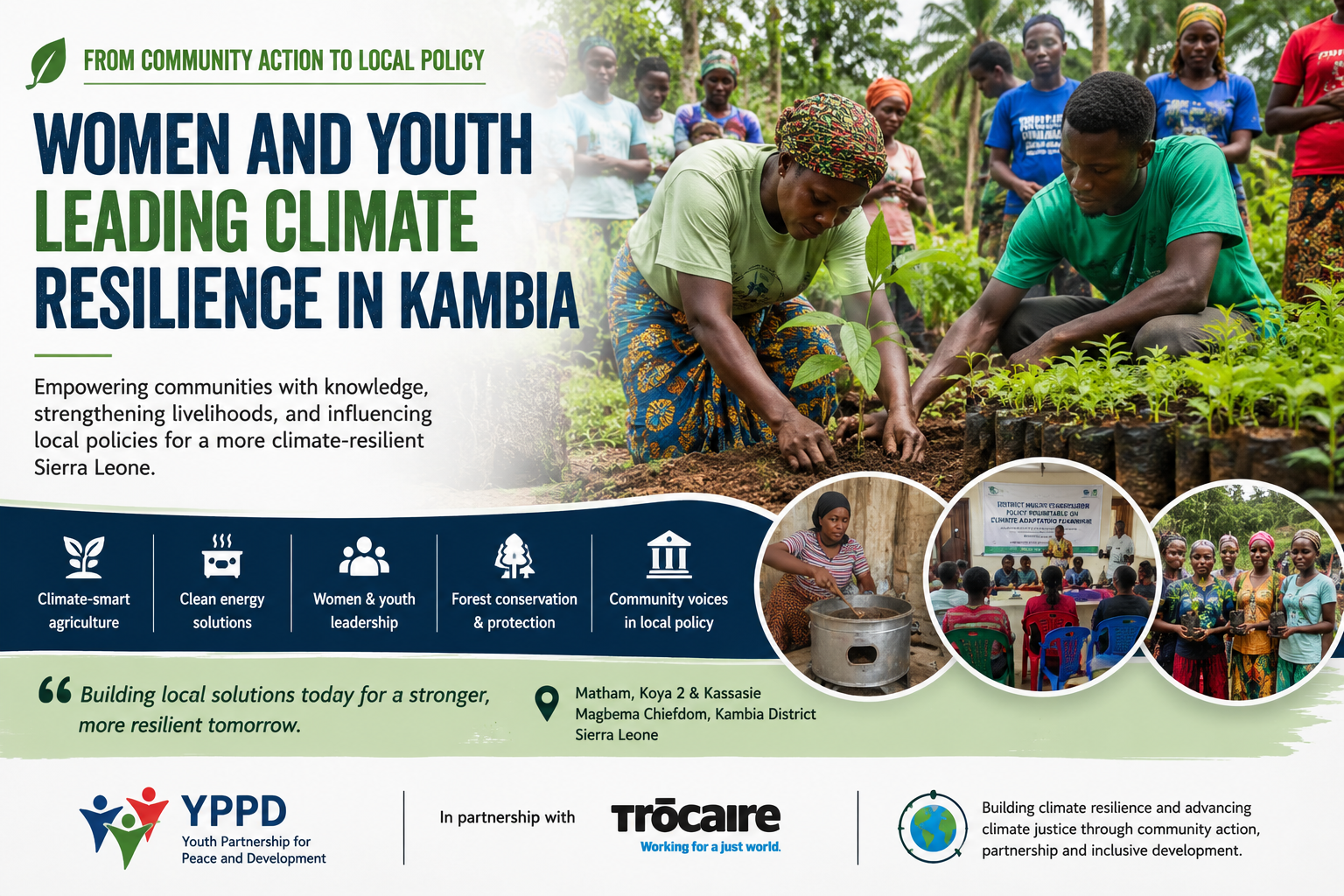
In Matham, Koya 2 and Kassasie, three communities in Magbema Chiefdom, climate change is not an abstract global issue. It is experienced through changing rainfall patterns, declining soil fertility, pressure on forests, flooding, reduced agricultural productivity and growing uncertainty for families whose livelihoods depend on natural resources. Yet these communities are also demonstrating what locally led climate action can look like.
Through the Women and Youth Leading Climate Justice: Advocacy and Action project, Youth Partnership for Peace and Development (YPPD), with support from Trócaire, is working alongside women, young people, farmers, community leaders, Forest Management Committees and government institutions to strengthen climate resilience while ensuring that those most affected by climate change have a meaningful role in shaping the response.
The emerging story from Kambia is one of more than training or awareness. It is about connecting knowledge with action, climate resilience with livelihoods, and community priorities with local government planning.
Building resilience from the ground up
Agriculture remains central to livelihoods in the project communities, making climate-resilient farming an important entry point for change.
In April 2026, YPPD partnered with the Ministry of Agriculture to conduct refresher training on agroecology and forest management across Matham, Koya 2 and Kassasie. Approximately 45 people participated in each community session, including smallholder farmers, women leaders, youth representatives, community leaders and members of Forest Management Committees.
Rather than relying only on classroom instruction, the training emphasized practical learning. Participants explored composting using locally available materials, mulching, crop diversification, organic pest control, agroforestry, tree nursery establishment, soil and water conservation and sustainable forest management. They also examined opportunities to connect environmental protection with income generation and small-scale agribusiness.
Follow-up coaching in May helped communities apply these lessons and address challenges as they emerged. Monitoring conducted later found evidence that these practices were being put to use. Community members reported preparing and applying organic fertilizer, adopting sustainable agricultural practices and improving production. In Koya 2, sustainable management of palm plantations was associated with increased palm fruit and palm oil production, while in Matham and Kassasie, participants also reported improved crop production and food security.
This progression—from training to practice—is important. Climate resilience becomes sustainable when communities can adapt knowledge to their own land, livelihoods and resources.
When climate action also strengthens livelihoods
One of the clearest lessons emerging from YPPD's work in Kambia is that environmental solutions can be more sustainable when they also improve people's economic opportunities. The introduction of briquette and improved cooking stove technologies provides an example.
Monitoring in Matham found widespread use of briquette stoves, with community members reporting reduced dependence on firewood and faster, more efficient cooking. Women trained through the project were also constructing improved stoves for neighbouring communities on a cost-recovery basis, generating income that supports household needs, including children's education.
Similar changes were documented in Koya 2, where women and young people were transferring their skills beyond the original participants by constructing stoves and demonstrating the technology to relatives and neighbouring communities.
These experiences illustrate an important principle for climate programming: the transition to more sustainable practices can simultaneously reduce environmental pressure and create economic opportunities.
YPPD's own monitoring identified this connection between climate action and livelihoods as a significant lesson for future programming.
Communities are creating their own mechanisms for sustainability
Perhaps some of the strongest signs of progress are actions communities have taken themselves.
Across all three project communities, communal farmland has been allocated to Village Development Committees. These farms are collectively managed, with proceeds intended to support committee operations and wider community development activities.
Communities have also established and enforced local by-laws against indiscriminate tree felling. In Kassasie, community members reported adopting a practice of planting two to three trees when a tree has to be removed for legitimate purposes.
These measures matter because they demonstrate that climate action is moving beyond externally facilitated activities toward local rules, institutions and resource mobilization.
Community leaders have reinforced that ownership in other ways. During the 2026 agroecology training, the Headman of Kassasie committed land for use by the Forest Management Committee, another community leader provided farmland for an agroecology demonstration site, and a Ministry of Agriculture Extension Officer committed to monitoring the demonstration sites.
These are relatively simple commitments, but together they help create the conditions for project benefits to continue beyond individual training cycles.
Putting women and young people at the centre of climate dialogue
Climate justice is also about who participates in decisions.
YPPD's partnership with Trócaire has deliberately created opportunities for women and young people to engage with both local and national climate issues.
During community awareness sessions held in June 2026, 60 participants—including 40 young women and 20 young men—explored Sierra Leone's Nationally Determined Contributions and the relevance of international climate processes.
The sessions did more than explain climate policy. Through storytelling, community mapping and focus group discussions, participants connected national climate commitments with their lived experiences of changing weather patterns, flooding, declining agricultural productivity, health risks, food insecurity and access to resources.
Young women, in particular, were provided space to describe how climate impacts affect their lives and to propose locally relevant solutions. Community experiences and traditional adaptation practices were documented to inform future programming and advocacy. Participants subsequently expressed interest in acting as climate ambassadors in their communities.
This approach helps bridge a persistent gap in climate action: the distance between global and national policy commitments and the everyday realities of communities.
From community plans to district decision-making
But local climate action cannot depend on communities alone.
For adaptation to be sustained and scaled, community priorities need pathways into the institutions responsible for planning, budgeting and public services.
This is where YPPD's work in Kambia has moved from community mobilization to policy engagement.
Through the project, Matham, Koya 2 and Kassasie developed Community Adaptation Plans reflecting their climate risks and locally identified priorities. YPPD subsequently convened a District Multi-Stakeholder Policy Roundtable on Climate Adaptation Planning, bringing community representatives together with Kambia District Council, technical departments, civil society actors and policymakers. The purpose was clear: move community priorities from standalone plans toward the formal planning and budgeting structures of the district. The three communities presented different but interconnected priorities. Matham emphasized climate-resilient agriculture and natural-resource protection. Koya 2 highlighted improved water access and sustainable adaptation measures. Kassasie called for stronger early action and community-level resilience.
Importantly, policymakers did not simply listen. The District Development Planning Officer affirmed that community adaptation priorities could be considered within the district planning cycle and committed to working toward reflecting the Community Adaptation Plans in the review of the District Development Plan. The District Agriculture Officer committed technical guidance on climate-smart agriculture, while a local councillor pledged to champion community priorities within Council deliberations. Civil society and women's representatives emphasized continued mobilization and inclusion, while the representative of persons with disabilities called for adaptation planning that explicitly addresses disability inclusion.
The roundtable therefore represented an important transition: from communities identifying their needs to communities negotiating how those priorities can enter formal development processes.
Local leadership, backed by responsive institutions
The Kambia District Council was also candid about the limitations it faces.
During the policy dialogue, the Deputy Chief Administrator acknowledged that limited resources and competing development priorities constrain the Council's ability to finance every community adaptation need.
But this acknowledgement came with practical commitments and guidance.
Communities were encouraged to formalize their structures through registration with the Council, participate in Council meetings, present their priorities and position themselves for opportunities from development partners and other funding sources. YPPD was encouraged to support community representatives to participate in these formal spaces.
The resulting commitments included recognition of the Community Adaptation Plans as legitimate inputs into district planning, a commitment to work toward their integration into the District Development Plan, stronger inclusion of women, youth and persons with disabilities, and continued collaboration among communities, government technical departments and civil society.
This is what locally led adaptation can look like in practice: communities bringing knowledge and priorities, civil society creating bridges, and government institutions opening pathways for those priorities to influence formal planning.
Learning and adapting along the way
Progress has not been without challenges. Monitoring identified limited farming tools, inadequate post-harvest storage and demand for additional livelihood opportunities. Growing participation has also placed pressure on existing Village Development Committees. In Kassasie, for example, the original committee became non-functional after several members moved away, prompting the establishment of a new committee to restore local project governance.
Weather itself has affected implementation. Heavy rainfall in August 2026 required YPPD to postpone planned practical refresher training on sustainable briquette production. Instead of forcing implementation under unsuitable conditions, the project redirected attention to documenting learning and preparing to reschedule the activity when conditions improved.
Such adaptation is itself part of climate-resilient programming: responding to changing conditions while protecting the quality and safety of interventions.
A partnership investing in more than activities
Across Matham, Koya 2 and Kassasie, the partnership between YPPD and Trócaire is demonstrating that community climate resilience is strongest when several elements come together.
Practical agroecological knowledge is helping farmers adapt. Cleaner cooking technologies are reducing pressure on forests while opening livelihood opportunities. Community by-laws are strengthening environmental stewardship. Women and young people are gaining greater space in climate discussions. Community institutions are mobilizing their own resources. And Community Adaptation Plans are creating a bridge between grassroots priorities and district-level decision-making.
The work also demonstrates the value of partnership itself.
YPPD brings local relationships, community mobilization, youth leadership and advocacy capacity. Trócaire's support provides the resources and partnership framework through which those capacities can be translated into sustained climate action. Government institutions, particularly the Ministry of Agriculture and Kambia District Council, provide technical expertise and pathways into public planning.
Together, these relationships are helping shift climate action from something done for communities toward something shaped and increasingly led by communities themselves.
For the women, young people and families of Matham, Koya 2 and Kassasie, the journey toward climate resilience is far from complete. Access to farming tools, storage, finance, diversified livelihoods and continued technical support remain important needs.
But the foundations are becoming visible—in farms using locally produced organic fertilizer, in households reducing their reliance on firewood, in women turning climate solutions into sources of income, in communities establishing rules to protect their forests, and in local representatives carrying Community Adaptation Plans into discussions with decision-makers.These are the building blocks of locally led climate resilience.
And in Kambia District, communities are showing that when local knowledge, inclusive leadership and responsive partnerships come together, climate justice can move from commitment to practice—and from community action to lasting systems change.
The Women and Youth Leading Climate Justice: Advocacy and Action project is implemented by Youth Partnership for Peace and Development (YPPD) with support from Trócaire in Matham, Koya 2 and Kassasie communities, Magbema Chiefdom, Kambia District, Sierra Leone.